For more than twenty years, I have taught watercolor classes to people from all walks of life.
Some come because they want to learn a new skill. Some are looking for a creative outlet. Others simply need a break from the demands of everyday life.
Over the years, I’ve noticed something that has little to do with artistic ability and everything to do with being human.
People often arrive carrying far more than paintbrushes and supplies.
They come carrying grief. Stress. Caregiver fatigue. Health challenges. Relationship struggles. Uncertainty about the future. Sometimes they are navigating major life transitions. Sometimes they are quietly surviving circumstances they have not shared with anyone in the room.
Yet something begins to shift when they sit down to create.
Their breathing slows.
Their shoulders soften.
They become absorbed in mixing colors, watching water move across paper, and responding to what unfolds in front of them.
For a little while, the constant demands of life loosen their grip.
As an artist, I’ve witnessed this transformation hundreds of times. As a trauma-informed coach, I’ve come to understand why it matters.
Let’s talk about art therapy for trauma.
When the Nervous System Has Been Working Overtime

Many women who have experienced betrayal trauma describe feeling as though they can never fully relax.
Their minds race with questions.
Their bodies remain alert for signs of danger.
Even during moments of rest, they may find themselves replaying conversations, searching for answers, or preparing for what might happen next.
This response makes sense.
Betrayal shakes our sense of safety. The nervous system responds by becoming highly attentive to potential threats in an effort to protect us.
While this protective response serves an important purpose, living in a constant state of vigilance can be exhausting. Over time, many women discover that they have forgotten what it feels like to simply be present.
Not because they are doing something wrong.
Because their bodies have been working incredibly hard to keep them safe.
The Gift of Becoming Absorbed – Nervous System Regulation Activities
One of the reasons creative activities can be so powerful is that they invite us into the present moment.
When we are focused on a brushstroke, selecting colors, shaping clay, stitching fabric, or arranging a collage, our attention shifts away from constant monitoring and problem-solving.
We are no longer trying to predict the future.
We are engaging with what is right in front of us.
This doesn’t erase pain. It doesn’t solve relationship challenges. It doesn’t replace therapy, support groups, or other healing resources.
What it can do is offer a brief experience of something many people desperately need: a pause.
A moment where the nervous system is invited to do something other than brace for impact.
Why Art Is Different Than Productivity
Many of us have become accustomed to measuring our worth through accomplishment.
We focus on checking items off lists, meeting obligations, and caring for everyone around us.
Even our hobbies can become performance-oriented.
Art offers an alternative.
The creative process asks us to experiment, explore, and respond rather than achieve.
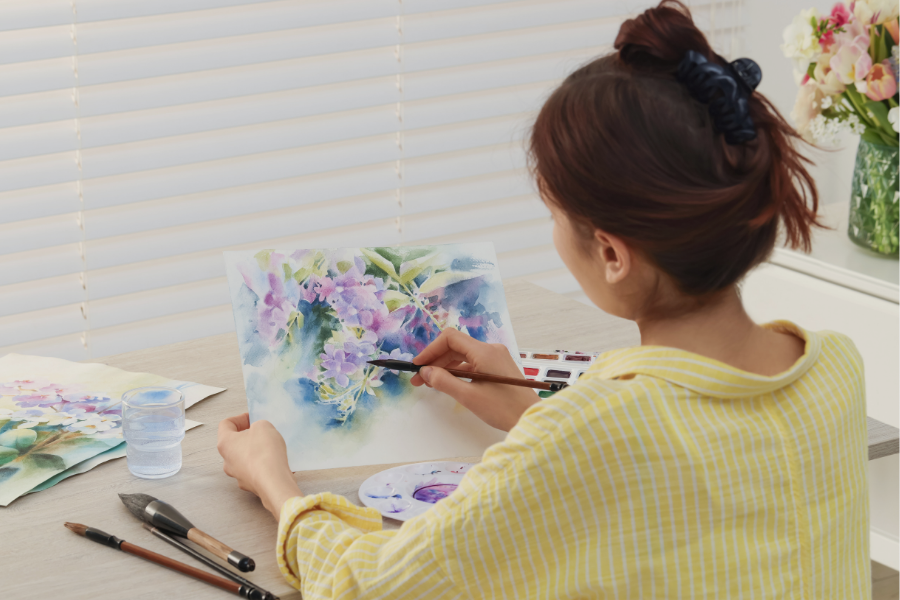
In my classes, I often remind students that watercolor has a mind of its own. The paint flows where it wants to flow. Sometimes the most beautiful results emerge from what initially appears to be a mistake.
There is something deeply healing about practicing flexibility in a world that often feels uncertain.
Creative expression allows us to engage with curiosity instead of control.
For women healing from betrayal trauma, that can be a meaningful experience.
Creating Small Islands of Restoration
I don’t believe healing requires grand gestures.
More often, it is built through small moments repeated over time.
A walk around the block.
Sitting outside with a cup of tea.
Calling a trusted friend.
Taking a few slow breaths.
Spending thirty minutes making art with no expectation of creating anything worthy of framing.
These moments may seem insignificant, but they help communicate something important to our nervous systems: we are allowed to rest.
Over the years, I have seen people leave art classes looking noticeably lighter than when they arrived. Not because their circumstances changed in two hours, but because they were given an opportunity to reconnect with themselves.
That experience matters.
An Invitation to Explore
You do not have to consider yourself artistic to benefit from creativity.
In fact, some of the people who receive the greatest benefit are those who begin by saying, “I’m not creative at all.”
The goal is not to produce great art.
The goal is to create space.
Space to breathe.
Space to notice.
Space to reconnect with parts of yourself that may have been overshadowed by stress, grief, or survival.
Healing after betrayal trauma involves many different pathways. Therapy, education, supportive relationships, and community all play important roles.
Creative expression is not a replacement for those resources.
But it can be a companion to them.
Sometimes a paintbrush, a piece of paper, and an hour of uninterrupted creativity can become a small act of self-care that reminds us what safety, presence, and possibility feel like again.
Learn more about Beth’s FREE monthly art workshop here.
Written by: Beth Woessner | Certified Trauma-Informed Coach, ICF Member