


I have worked with thousands of clients, and one of my favorite approaches is guided imagery—for letting go of something from the past and, perhaps even more importantly, for creating a new identity.
When someone is struggling with sexual compulsivity, one of the most painful parts of the experience can be feeling trapped by images they may have never intentionally chosen or that they don’t want anymore.
A person may have spent years consuming pornography or engaging in sexual fantasy, and those images can become deeply embedded in their memory. Then, seemingly out of nowhere, an image appears.
Their body reacts. Their emotions change. Their cravings intensify. They may think, Why am I doing this again? Why can’t I just stop thinking about it? What’s wrong with me?
I believe there is another way to understand what is happening.
Our Brains Respond to Images
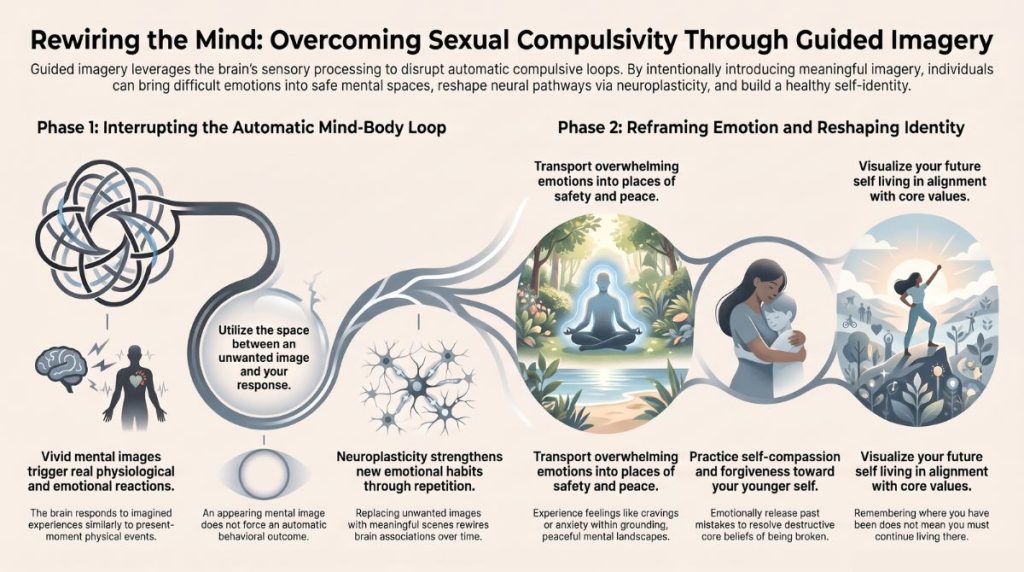
The brain is incredibly responsive to images. And that same capacity that can keep unwanted images alive can also become a pathway toward healing.
Guided imagery works, in part, because of two fascinating characteristics of the brain and body.
First, many memories are encoded and retrieved through sensory information—including images, sounds, sensations, and emotions. Words can describe an experience, but an image can make an experience feel immediate and alive.
Second, our brains and bodies can respond to vividly imagined experiences in ways that resemble their responses to real experiences. Think about what happens when you imagine biting into a sour lemon. You can picture cutting it open, squeezing the juice onto your tongue, and tasting that intense sourness.
There may be no lemon anywhere near you, yet your mouth may begin producing saliva.
The same principle can apply to sexual imagery. Someone can think about a sexual fantasy when no one else is around, and their body may respond as though the imagined experience is happening in the present moment.
The mind creates the image, and the body responds.
For someone struggling with sexual compulsivity, this very real mind-body connection can become painful.
A person may have accumulated thousands of unwanted sexual images over the years. When one of those images appears, the body can react almost automatically.
But here’s the part I want my clients to understand: An image appearing in your mind does not mean you have to follow it. There is a space between the image and the response.
And in that space, we can begin practicing something new.
Learning to Shift the Image
One of the most powerful things we can learn is how to transition from an unwanted image into an image that represents something meaningful to us.
This isn’t about fighting the unwanted image. In fact, trying desperately to force an image out of our minds can sometimes make us think about it even more.
Instead, I often teach clients to acknowledge what is happening and then intentionally introduce a different scene.
For someone whose faith is central to their recovery, perhaps they imagine themselves in the middle of an unwanted sexual image and then picture themselves surrendering everything to their Higher Power.
They might visualize placing the images, the cravings, the shame, and the pain into God’s hands and watching as they no longer have to carry everything themselves.
For someone else, the image might be completely different. It might be a mountain, a beach, a quiet forest, a meaningful memory, a picture of their children, or a future version of themselves.
The specific image matters less than what it represents. When we create an image that carries deep personal meaning, we aren’t merely distracting ourselves. We are practicing a different emotional and physiological response.
And with repetition, that practice can become easier.
This is one way I think about the brain’s capacity for neuroplasticity—its ability to change through repeated experiences and patterns.
When I talk with clients about “rewiring the brain,” I don’t mean that one visualization magically erases an old pathway. I mean that repeatedly practicing a new way of responding can help strengthen new associations and habits over time.
Take the Emotion With You

I once asked a client, “What brings you the most peace in your life?”
Without hesitation, he told me about being at the top of the alpine mountains here in Utah. So I asked him a question: “What would change in your life if you could be up there for just a few minutes every day?”
He thought about it and explained that it would completely change the way he approached his life if he could be up there daily. He imagined being able to pause, breathe, look across the mountains, and become grounded on top of the mountain before returning home after work.
I told him there was a way to practice this and get better at feeling the same feelings as you would being up there .
Through deep guided imagery, we can quiet everything down and bring that mountain scenery into our minds. We can picture the colors, the temperature, the elevation, the sounds, and the openness of the landscape.
More importantly, we can reconnect with what that place represents to us: peace, strength, perspective, safety, and grounding.
And then something interesting happens. We don’t necessarily have to make the difficult emotion disappear. We can take it with us to the top of the mountain.
Maybe we take our anxiety with us. Maybe we take our shame. Maybe we take our loneliness.
Maybe we take the sexual craving. Instead of saying, I can’t feel this, we can say, I’m going to feel this while I stand here.
The same could happen on a beach, sitting near a beautiful jetty, watching the water move while imagining the crabs and sea life beneath the surface.
The goal isn’t always to push the unwanted emotion away. Sometimes the goal is to change our relationship with it. When we bring an overwhelming emotion into a place of safety, meaning, or peace, something inside the body can begin to shift.
Creating a New Identity

This is where guided imagery becomes even more powerful.
Many people struggling with sexual compulsivity don’t just struggle with behavior.
They struggle with identity. They may think, I’m broken. I’m a failure. I’ll always be this way. I’m not worthy of love. I’ll never change. These beliefs can become almost as destructive as the behavior itself.
So I invite clients to create a different image. I might ask them to imagine themselves years from now—not as someone who has had a perfect life, but as someone who has learned, grown, healed, and become stronger.
What does that person look like? How do they carry themselves? What have they learned? What do they now understand about themselves?
What lessons could they someday share with their children, their spouse, a friend, or another person who is struggling?
Then I invite them to do something even deeper. Imagine seeing their younger self. The younger version who made mistakes.
The younger version who didn’t have the tools they have today. The younger version who was hurting, confused, lonely, or simply trying to cope with life the best way they knew how.
Then imagine their present self looking at that younger person with compassion and perhaps saying, “I forgive you. You didn’t know what I know now. You don’t have to carry this forever. I’m going to take it from here.”
Don’t just imagine saying those words. Feel them. Feel what forgiveness might feel like in your chest. Feel what compassion might feel like in your body.
Feel what it might be like to finally stop fighting yourself. That is where imagery can become more than imagination. It becomes an emotional experience.
We Can Remember Without Continuing to Live There
One of the most important lessons I try to teach my clients is this: We can remember where we have been without continuing to live there. Your past may explain some of your struggles, but it does not have to dictate your identity.
The images that have been anchored in your mind for years may have influenced how you see yourself and your world. But new images can be created.
New experiences can be practiced. New beliefs can develop. And with repetition, those new patterns can become increasingly familiar. We can create an image of ourselves choosing differently.
An image of ourselves standing in our strength. An image of ourselves forgiving our younger self. An image of ourselves turning toward our values instead of running toward an old coping mechanism.
An image of ourselves becoming the parent, partner, friend, or person we want to become.
The goal isn’t to pretend the past never happened.
The goal is to take everything we learned from the past and use it to create a different future.
That, to me, is one of the most beautiful possibilities of guided imagery. We don’t have to erase our history. We don’t have to pretend we weren’t hurt.
We don’t have to deny the images that still come to mind. We can learn to see something different. And eventually, through practice, we can begin to feel something different, too.
Interested in taking a step toward healing? Learn more about Choose Recovery Services today.

Written by: Jacob Fletcher | CMHC, CSAT, CBT, IFS, EMDR, ART


